"Our ROAS is 2.5" sounds good, until you learn the product needs a ROAS of 3 just to break even. Break-even ROAS is the number that tells you whether an ad result is a win or a slow loss, and you can calculate it before spending anything.
What ROAS and break-even ROAS mean
- ROAS (return on ad spend) = revenue from ads ÷ ad spend. A ROAS of 3 means $3 of sales for every $1 spent.
- Break-even ROAS is the ROAS at which the profit from a sale exactly pays for the ads that produced it. Below it you lose money on every ad-driven sale; above it you make money.
The formula
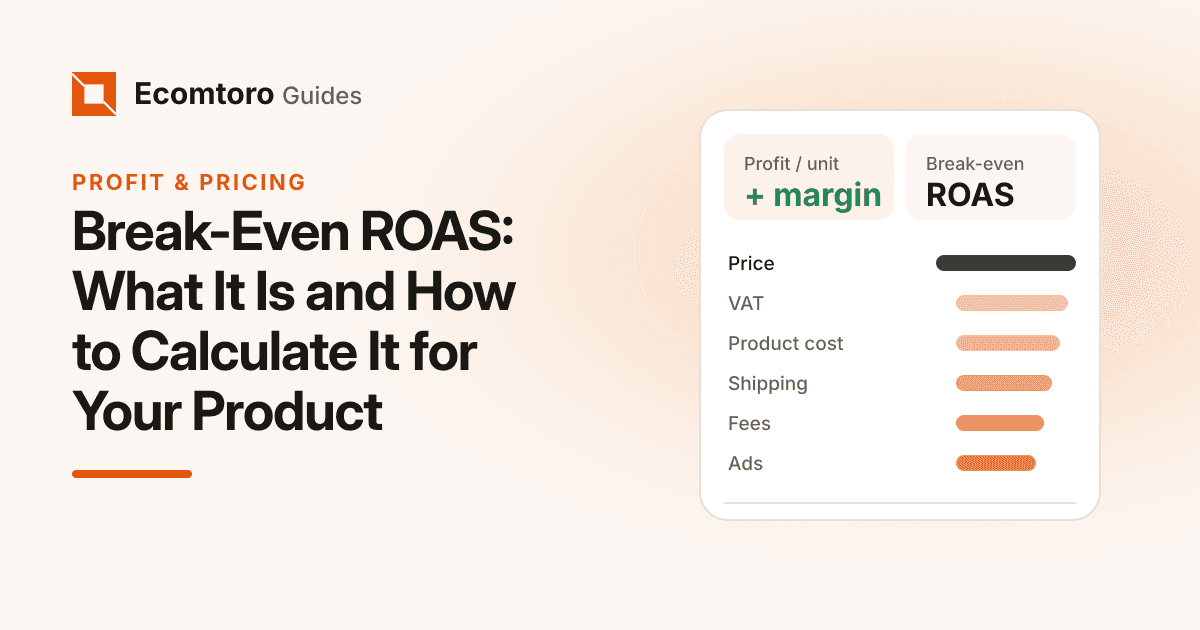
Break-even ROAS = revenue per sale ÷ profit per sale before advertising
Where profit before advertising is the selling price minus VAT, product cost, shipping, duty and all channel and fulfilment fees, but not ad costs.
Use the same revenue definition your ad platform uses. Ad platforms usually report the purchase value the customer paid, which in the UK and EU includes VAT, so use the VAT-inclusive price there.
Worked example
A product sells for £24.99 on Amazon.co.uk. Using the costs from our Amazon FBA profit guide (fees assumed for illustration):
| Line | Amount |
|---|---|
| Price paid by the customer | £24.99 |
| VAT (20%) | £4.16 |
| Product, shipping and duty | £5.10 |
| Referral and FBA fees | £7.25 |
| Profit before ads | £8.48 |
Break-even ROAS = £24.99 ÷ £8.48 ≈ 2.95
So a campaign reporting a ROAS of 2.5 is losing money on this product, and a ROAS of 4 is profitable.
Break-even ACoS for Amazon ads
Amazon Ads reports ACoS (advertising cost of sale) instead of ROAS. It is the inverse: ACoS = ad spend ÷ ad revenue.
Break-even ACoS = 1 ÷ break-even ROAS
In the example: 1 ÷ 2.95 ≈ 34%. An ACoS below 34% is profitable, above it is not.
How to use the number
- Before launch: if your break-even ROAS is very high, the product needs cheaper costs, a higher price or a bundle before you advertise.
- When reading results: compare every campaign's ROAS with your break-even, not with an industry average.
- When setting targets: set a target above break-even so there is real profit left, for example a margin you want to keep per sale.
- When changing price: a discount lowers profit before ads, which raises your break-even ROAS. Recalculate before running a sale.
Ways to lower your break-even ROAS
- Raise average order value with bundles or multipacks.
- Cut landed cost: negotiate with the supplier, or ship by sea instead of air.
- Choose a size and packaging that falls into a cheaper fulfilment tier.
- Sell in a market with lower fees or VAT for your product.
Calculate it automatically
Ecomtoro calculates profit per unit, net margin, ROI and break-even ROAS for each product in the US, UK and Germany, including VAT, duty and channel fees, so you know your target before your first ad goes live.
Frequently asked questions
What is a good ROAS?
Any ROAS above your product's break-even ROAS is profitable. A good target leaves the profit you want per sale, so it depends on your margin rather than an industry benchmark.
Should I use the price with or without VAT for break-even ROAS?
Use the same revenue your ad platform reports. Platforms usually report what the customer paid, which includes VAT in the UK and EU, so use the VAT-inclusive price and subtract VAT inside the profit calculation.
How do I convert break-even ROAS to break-even ACoS?
Divide 1 by the break-even ROAS. A break-even ROAS of 2.95 equals a break-even ACoS of about 34%.